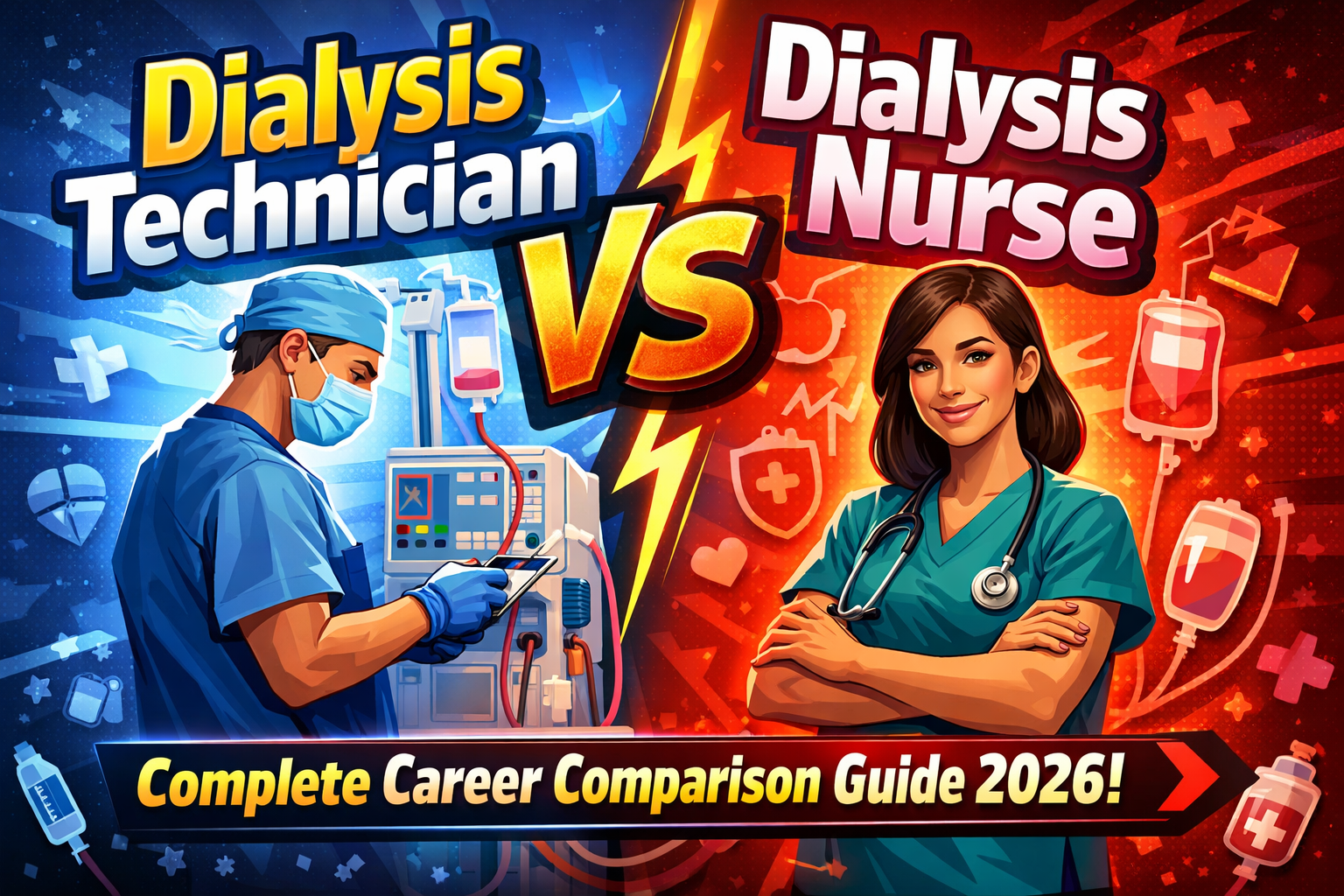
Dialysis Technician vs Dialysis Nurse: Complete Career Comparison Guide 2026
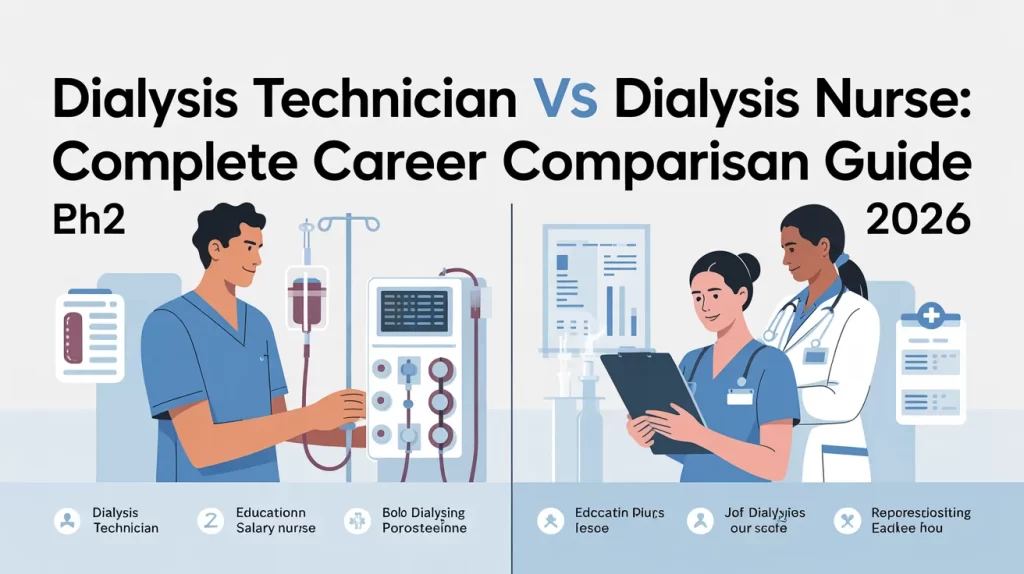
Dialysis technician vs dialysis nurse—this comparison question confronts thousands of aspiring renal healthcare professionals choosing between two closely related yet distinctly different career paths. Both dialysis technicians and dialysis nurses work with kidney failure patients, operate life-sustaining dialysis equipment, and play critical roles in renal care teams. Yet they differ significantly in educational requirements, scope of practice, compensation, career advancement, and professional responsibilities. Understanding the nuanced differences in dialysis technician vs dialysis nurse careers helps you make informed educational and career decisions aligned with your goals, capabilities, and circumstances. This comprehensive guide examines every dimension of dialysis technician vs dialysis nurse comparisons—from training duration to salary progression, job responsibilities to career flexibility—while exploring how institutions like DCDC Academy of Healthcare prepare dialysis technicians for successful, rewarding careers.
Dialysis Technician vs Dialysis Nurse: Understanding Core Differences
The fundamental distinction in dialysis technician vs dialysis nurse comparisons lies in educational preparation, regulatory scope, and professional autonomy.
Educational Pathway Comparison
Dialysis Technician:
- Duration: 18-24 months diploma program
- Prerequisites: 12th standard or graduate degree (any stream)
- Entrance Exams: None required
- Educational Investment: ₹1-3 lakhs total
- Examples: DCDC Academy’s 2-year diploma program
Dialysis Nurse:
- Duration: 3-4 years (GNM/B.Sc. Nursing) + 6-12 months dialysis specialization
- Prerequisites: 12th standard with Physics, Chemistry, Biology
- Entrance Exams: NEET, state nursing entrance tests
- Educational Investment: ₹3-8 lakhs total
- Licensure: Mandatory state nursing council registration
Verdict: Dialysis technician pathway is shorter, more accessible, and less expensive.
Scope of Practice
Dialysis Technician:
- Operating dialysis machines and equipment
- Performing vascular access cannulation (under physician protocol)
- Monitoring patient vital signs during treatment
- Recognizing complications and alerting clinical team
- Maintaining infection control and quality standards
- Documenting treatment parameters and patient responses
Dialysis Nurse:
- Everything technicians do PLUS:
- Independent patient assessment and care planning
- Administering medications and injections
- Managing complex medical interventions
- Patient education on disease management
- Coordinating with nephrologists on treatment modifications
- Supervising dialysis technicians
Verdict: Nurses have broader clinical autonomy and greater scope of independent practice.
Dialysis Technician vs Dialysis Nurse: Detailed Comparison
1. Salary and Compensation
Dialysis Technician Salaries:
- Entry-level: ₹15,000 – ₹28,000 monthly
- Mid-career (5 years): ₹35,000 – ₹55,000 monthly
- Senior (10+ years): ₹60,000 – ₹85,000 monthly
- Management: ₹1,00,000 – ₹2,00,000+ monthly
Dialysis Nurse Salaries:
- Entry-level: ₹18,000 – ₹35,000 monthly
- Mid-career (5 years): ₹40,000 – ₹70,000 monthly
- Senior (10+ years): ₹70,000 – ₹1,10,000 monthly
- Management: ₹1,20,000 – ₹2,50,000+ monthly
Verdict in Dialysis Technician vs Dialysis Nurse Earnings: Nurses earn 15-25% higher across experience levels, but technicians achieve faster ROI due to lower educational investment and earlier employment start.
2. Time to Employment
Dialysis Technician:
- 2 years training → immediate employment
- Start earning at age 19-20 if pursuing after 12th
- 2-year head start over nursing graduates
Dialysis Nurse:
- 3.5-4.5 years training → employment
- Start earning at age 21-22 minimum
- Additional licensing examinations before practice
Verdict: Technicians enter workforce 2 years earlier, accumulating experience and earnings while nurses are still studying.
3. Work Responsibilities and Stress
Dialysis Technician:
- Focused, specialized role in dialysis procedures
- Lower clinical decision-making stress
- Predictable responsibilities
- Less documentation burden
- Team member rather than team leader
Dialysis Nurse:
- Broader clinical responsibilities across patient care
- Higher decision-making authority and accountability
- Medication administration adds complexity
- Extensive documentation requirements
- Leadership and supervisory duties
Verdict in Dialysis Technician vs Dialysis Nurse Stress: Technicians experience more manageable stress levels and clearer role boundaries.
4. Career Advancement Pathways
Dialysis Technician:
- Junior Technician → Senior Technician → Shift Supervisor → Unit Manager → Regional Operations Manager
- Specialization in water treatment, quality assurance, infection control
- Transition to equipment company positions (clinical specialists, trainers)
- International opportunities (Gulf countries particularly strong)
- Entrepreneurship (opening dialysis centers)
Dialysis Nurse:
- Staff Nurse → Senior Nurse → Nurse In-charge → Nursing Supervisor → Director of Nursing
- Specialization in critical care dialysis, peritoneal dialysis, pediatric dialysis
- Advanced degrees (M.Sc. Nursing, MBA Healthcare)
- Administrative and policy-making roles
- Broader healthcare sector mobility
Verdict: Both offer clear advancement, but nurses have wider healthcare sector options while technicians excel in dialysis-specific entrepreneurship.
5. Job Availability and Market Demand
Dialysis Technician:
- High demand with limited qualified supply
- Easier job placement immediately after training
- Growing industry creating 5,000+ annual positions
- Less competition due to specialized nature
Dialysis Nurse:
- High demand but more competition
- General nursing oversupply in some markets
- Dialysis specialization improves marketability
- Broader healthcare options beyond dialysis
Verdict in Dialysis Technician vs Dialysis Nurse Job Market: Technicians currently face easier placement in dialysis-specific roles; nurses have more diverse options.
6. Work-Life Balance
Dialysis Technician:
- Shift-based work (8-12 hours)
- Scheduled patient treatments (predictable)
- Weekend/holiday rotations required
- Rare emergency call-ins
- Generally good work-life balance
Dialysis Nurse:
- Similar shift structure in dialysis units
- Additional documentation extending work hours
- On-call requirements in some facilities
- Supervisory responsibilities may disrupt schedules
- Slightly more demanding overall
Verdict: Both offer reasonable work-life balance; technicians have slight edge in predictability.
7. Educational Accessibility
Dialysis Technician:
- Open to all academic streams (science, commerce, arts)
- No competitive entrance examinations
- Lower financial barriers
- Shorter commitment duration
- Available in more cities and institutes
Dialysis Nurse:
- Mandatory science background (PCB in 12th)
- Competitive entrance exams (NEET, state tests)
- Higher financial investment
- Longer educational commitment
- Limited seats in quality nursing programs
Verdict in Dialysis Technician vs Dialysis Nurse Accessibility: Technician pathway dramatically more accessible to average students from diverse backgrounds.
DCDC Academy of Healthcare: Excellence in Dialysis Technician Training
For those deciding dialysis technician vs dialysis nurse and choosing the technician pathway, DCDC Academy of Healthcare offers comprehensive preparation with guaranteed employment.
The DCDC 2-Year Diploma Advantage
Structured Three-Phase Training:
Phase 1: Theoretical Foundation (6 Months)
Comprehensive medical education covering:
- Complete anatomy, physiology, and nephrology
- Dialysis technology and equipment science
- Patient assessment and clinical protocols
- Quality systems and infection control
- Professional communication and ethics
Smart classroom technology and experienced clinical faculty ensure thorough understanding.
Phase 2: Practical Laboratory Training (6 Months)
Intensive hands-on skill development:
- Dialysis machine operation mastery
- Cannulation technique excellence
- Complication recognition and emergency response
- Equipment troubleshooting and maintenance
- Quality control procedures
Modern, well-equipped labs with current-generation equipment ensure job-readiness.
Phase 3: On-Job Training with Stipend (12 Months)
Real-world clinical experience:
- Full year of supervised practice in functioning dialysis units
- Hundreds of actual patient treatments logged
- Professional network development
- Monthly stipend (₹8,000 – ₹15,000) while training
Employment Pipeline: Through exclusive DCDC Kidney Care partnership, graduates receive priority hiring and seamless transition from training to employment.
Eligibility: Open to All
Educational Requirements:
- 12th standard from any recognized board
- OR any graduate degree from any university
- All streams accepted: Science, Commerce, Arts
Age Requirement:
- Minimum 17 years
Learning Modes:
- Offline campus-based education
- Online virtual learning with flexibility
- Both include in-person practical and clinical training
Course Highlights
100% Job Placement: Guaranteed employment through DCDC Kidney Care partnership and broader employer network
Stipend During OJT: Earn while learning, reducing financial burden
Experienced Clinical Faculty: Real-world professionals teaching practical, applicable skills
Modern Infrastructure: Smart classes and contemporary labs preparing you for modern facilities
Decision Framework: Dialysis Technician vs Dialysis Nurse
Choose Dialysis Technician if you: ✓ Want faster entry to workforce (2 years vs 4 years) ✓ Don’t have science background in 12th standard ✓ Prefer focused, specialized role over broad nursing ✓ Want lower educational investment (₹1-3 lakhs vs ₹3-8 lakhs) ✓ Seek entrepreneurship opportunities (opening dialysis centers) ✓ Value predictable responsibilities and manageable stress ✓ Want easier job placement with less competition ✓ Prefer not to administer medications or make complex clinical decisions
Choose Dialysis Nurse if you: ✓ Already have or can obtain science background ✓ Want broader clinical scope and autonomy ✓ Seek higher long-term salary ceiling ✓ Desire leadership and supervisory roles ✓ Want healthcare sector mobility beyond dialysis ✓ Comfortable with medication administration and complex decisions ✓ Willing to invest 4+ years in education ✓ Can navigate competitive entrance examinations
Real Professional Perspectives
Dialysis Technician (DCDC Graduate): “I chose technician over nursing because I could start working at 20 instead of 22-23, and I didn’t want to spend years preparing for competitive exams. Two years after graduating from DCDC Academy, I’m earning ₹38,000 monthly as a senior technician—more than some of my friends who just finished nursing and are starting at ₹20,000. The focused role suits me perfectly.” — Rahul, 24, Delhi
Dialysis Nurse: “The nursing degree gives me options. I work in dialysis now, but I could transition to ICU, oncology, or management if I wanted. The broader scope was worth the extra education time for me, though I respect technicians—they’re highly skilled professionals essential to our team.” — Priya, 27, Mumbai
Dialysis Technician vs Dialysis Nurse: Summary Comparison
| Factor | Dialysis Technician | Dialysis Nurse |
|---|---|---|
| Education Duration | 2 years | 4-4.5 years |
| Educational Cost | ₹1-3 lakhs | ₹3-8 lakhs |
| Entry Requirements | 12th (any stream) | 12th (PCB) + entrance exam |
| Entry Salary | ₹15,000-28,000 | ₹18,000-35,000 |
| Senior Salary | ₹60,000-85,000 | ₹70,000-1,10,000 |
| Time to Employment | 2 years | 4-4.5 years |
| Job Availability | Excellent | Good |
| Scope of Practice | Equipment-focused | Broad clinical care |
| Stress Level | Moderate | Moderate-High |
| Advancement | Dialysis-specialized | Healthcare-wide |
| Accessibility | Very High | Moderate |
Contact DCDC Academy: Begin Your Dialysis Technician Journey
Chosen the dialysis technician pathway in dialysis technician vs dialysis nurse comparison?
Phone:
- 011 – 45552688
- +91 – 8929067521
Email: academy@dcdc.co.in
Website: https://dcdc.co.in
Visit: DCDC Academy of Healthcare B-22, Basement Opposite Metro Pillar No. 225, Block C New Multan Nagar, Paschim Vihar Delhi – 110056
Accessible via Paschim Vihar Metro Station
Final Verdict: Dialysis Technician vs Dialysis Nurse
Dialysis technician vs dialysis nurse—which is better? Neither is universally superior; the right choice depends on your circumstances:
Dialysis Technician is objectively better for:
- Faster workforce entry and earlier earnings
- Students without science backgrounds
- Those seeking lower educational investment
- Focused, specialized career paths
- Easier job placement and less competition
- Dialysis-specific entrepreneurship
Dialysis Nurse is objectively better for:
- Broader clinical scope and autonomy
- Higher long-term salary ceilings
- Healthcare sector mobility
- Leadership aspirations
- Those who already have science background
For most students prioritizing accessibility, faster employment, lower investment, and focused career paths, dialysis technician emerges as the practical choice. DCDC Academy’s comprehensive 2-year program with DCDC Kidney Care partnership guaranteeing placement makes this pathway even more attractive.
Your rewarding renal healthcare career awaits. Contact DCDC Academy today and begin your journey as a skilled, valued dialysis technician.